
When analysing a ceramic tile installation, it’s common for all the attention to fall on the visible finish. The design of the tile, its format, texture, colour, or the cleanliness of the installation are all evaluated. However, the actual performance of the entire system is determined earlier, during the preparation of the substrate and its compatibility with the tiling.
This point is critical when the goal is to prevent the appearance of cracks, deformations, or water leaks. These are problems that usually show up on the surface but rarely originate there. Most often, they stem from movements in the substrate, accumulated stresses, poorly managed residual moisture, or insufficient protection beneath the ceramic tiles. That’s why, if the objective is to achieve a long-lasting installation, it’s not enough to choose the right finishing material. You also need to pay attention to the elements that protect it from the very beginning.
Among those elements, the base membrane plays a decisive role. It doesn’t provide any aesthetic prominence and isn’t visible once the project is complete, but it directly influences the stability of the entire system. Its function is to work alongside the substrate, decouple behaviours, improve protection against water, and help the tiling maintain its integrity over time.
In many projects, it’s taken for granted that if the base appears uniform and strong, the tiling will perform well. However, the substrate is not a passive surface. It can experience expansions, contractions, changes caused by temperature, retained moisture, or stresses resulting from the use of the space. Even though these movements aren’t always visible, they can end up affecting the top layer if there’s no solution in place to help separate them from the finish.
This is why so many problems appear long after project handover. At first glance, the installation may look correct, but if the substrate transmits stresses to the ceramic tiles, the system will eventually show signs of fatigue. A crack in a tile, an opening joint, or a moisture-sensitive area are rarely isolated failures. They indicate that the base and the tiling were not working in a compatible way.
Understanding this changes how the entire project is approached. It’s no longer just about laying the surface correctly, but about creating the conditions for it to remain stable for a longer period. Preparing the substrate thus becomes a performance factor, not just a preliminary step.

In construction, few decisions are as cost-effective as those that prevent a problem before it occurs. Cracks and leaks are a great example. Both require intervention after the work is already finished, damage client confidence, and almost always involve additional costs.
In the case of cracks, the cause is usually related to stresses that the tiling was unable to absorb. Even if the ceramic tiles were installed correctly, if they receive movements from the substrate, they will show them in the form of fissures, openings, or deformations. Leaks follow a similar logic. When the base does not have effective protection against water, moisture can find a weak point and advance to compromise the installation.
That’s why an appropriate membrane should not be viewed as just an added layer, but as a preventive measure. Incorporating it from the initial phases helps limit risks and protect the finish without altering the planned solution.
Within this preventive approach, a solution like the Euromembrane MDES30 makes perfect sense. It is a decoupling and waterproofing membrane designed to optimize the installation of ceramic coverings and improve the overall system’s performance right from the base.
Its main contribution is to decouple the substrate from the tiling – in other words, to help ensure that movements in the base are not transmitted directly to the ceramic surface. This is key to reducing the risk of cracks and deformations, especially in contexts where the substrate may experience stresses or minor dimensional variations.
In addition to this function, it offers a waterproofing capability, which is particularly valuable in areas exposed to moisture. Bathrooms, showers, kitchens, or spaces where water is a regular part of use require effective protection beneath the finish. Incorporating a membrane that contributes to this watertightness strengthens the safety of the system and minimizes the possibility of leaks.
In addition, Euromembrane MDES30 promotes vapour pressure compensation, helping to dissipate any residual moisture present in the substrate. This aspect is important because poorly managed moisture can eventually affect the performance of the tiling even when the finish appears correct. Along with this, the membrane also helps distribute loads more uniformly, which improves performance on surfaces subject to heavy traffic or point loads.
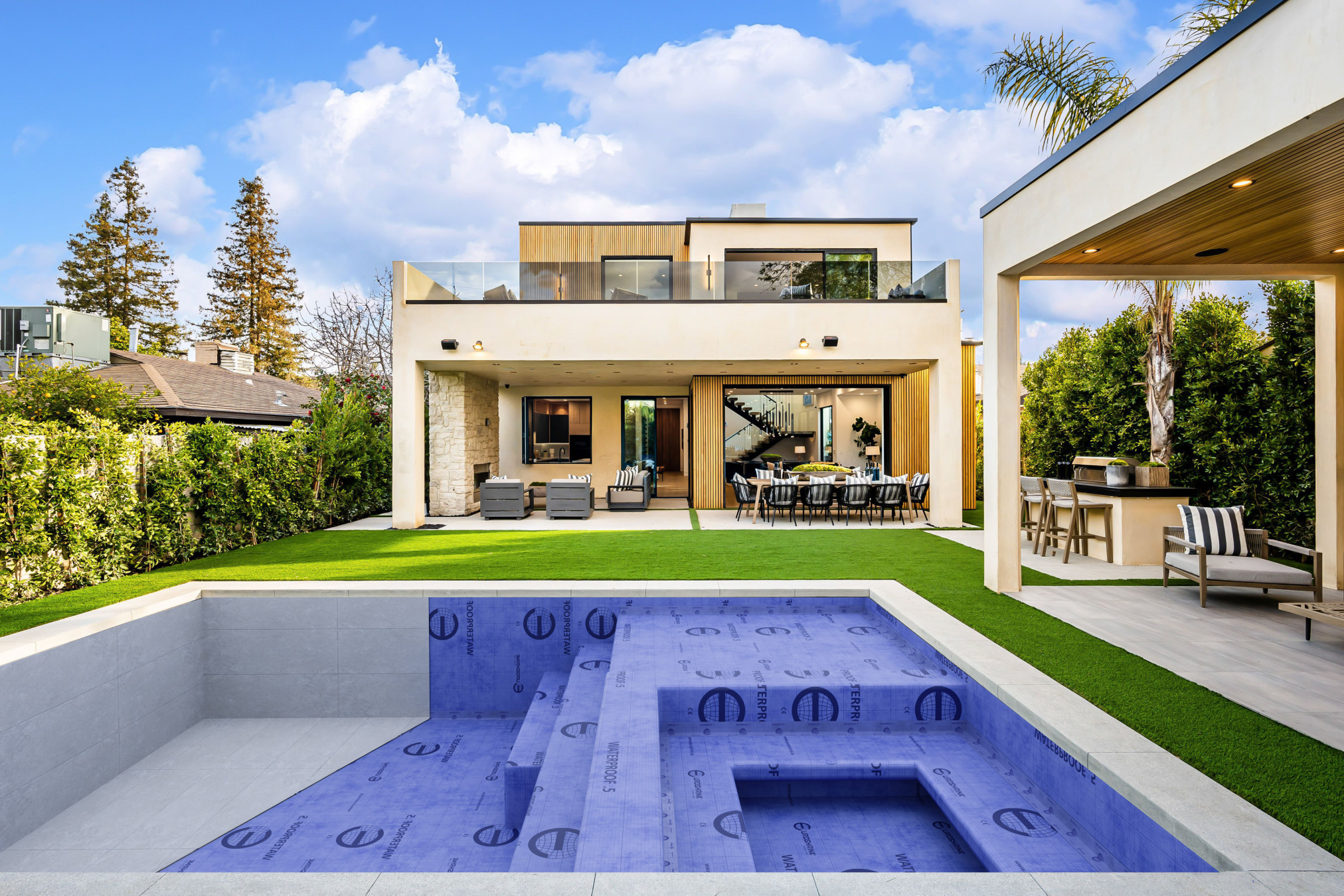
The value of this solution is best appreciated in the long-term behaviour of the installation. By limiting the transmission of stresses and improving base protection, the tiling has better conditions to remain stable over time.
Durability is measured precisely here: in the system’s ability to maintain its stability in the face of use, ambient humidity, thermal changes, and substrate stresses. When the base is properly addressed, the ceramic surface better preserves its integrity and reduces the need for corrective interventions.
Its value, therefore, does not lie in promising an absolute solution, but in reducing the likelihood of issues by improving the working conditions of the entire system. This preventive capacity is what justifies its use in projects where reliability matters.
As with any construction solution, the product’s performance must be paired with proper execution. For the membrane to work correctly, the substrate must be clean, level, strong, and free of any elements that could hinder adhesion. It is also important to use a compatible adhesive and ensure correct installation, with well-resolved joints and the system prepared to receive the tiling under optimal conditions.
Choosing a good base membrane follows this logic. It allows movements to be decoupled, strengthens waterproofing, better manages residual moisture, and helps distribute loads more evenly. All of this translates into a very concrete outcome: less risk of cracks, less chance of leaks, and greater guarantees of durability for the ceramic tiling.
In short, the quality of a ceramic tile installation also depends on how the supporting layer beneath it is prepared and protected. When that base is handled thoughtfully, the result not only looks good when the project is completed – it also delivers more reliable performance over time. If you would like to learn more about Euromembrane MDES30 or find the most suitable solution for your project, contact us.